| |
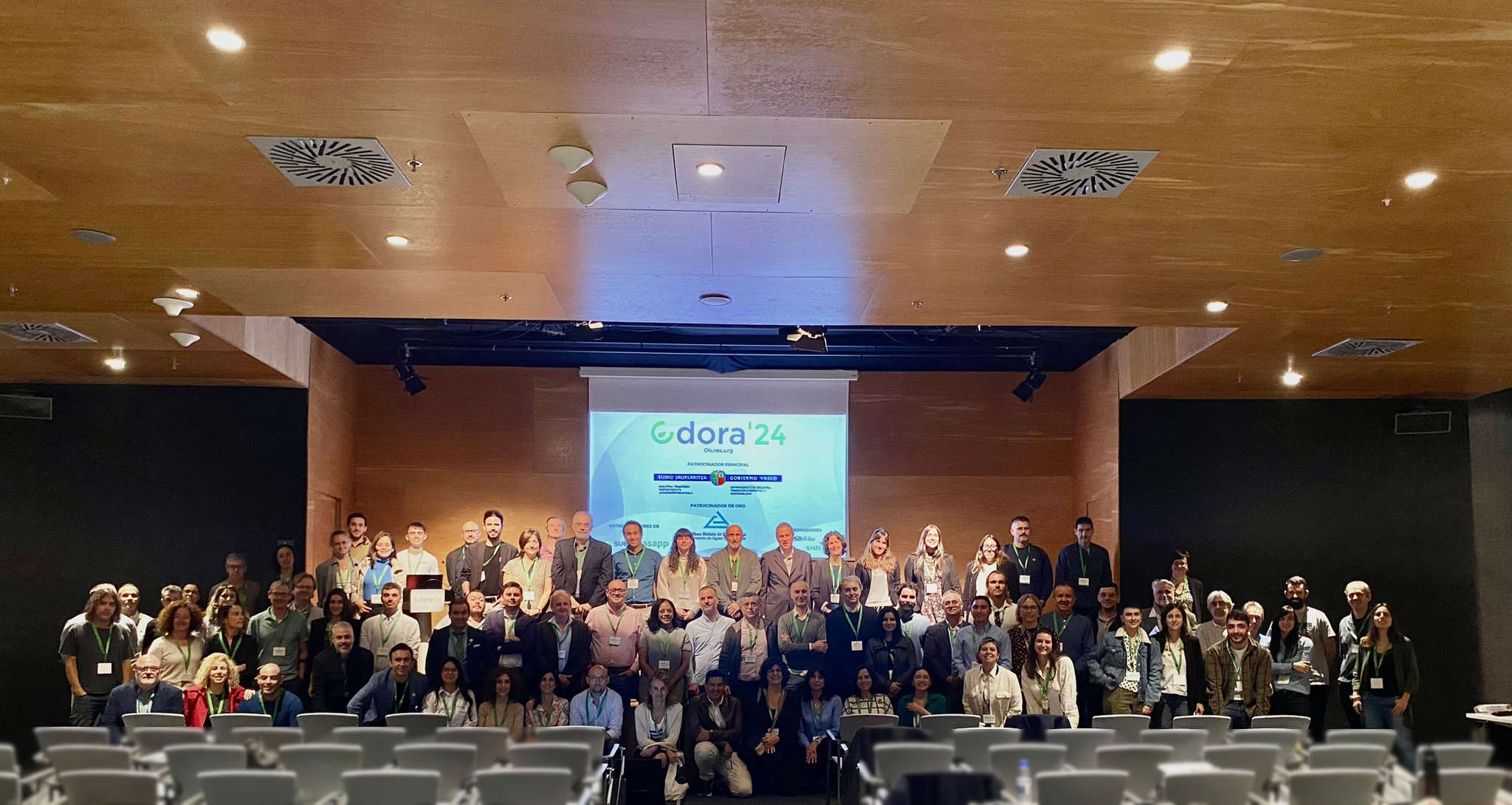
The ODORA24 conference took place on the 5th and 6th of November and was a complete success. Initially, 125 people from 9 countries had registered, but due to the flooding disasters in the Valencia area and the red alert in the Catalonia area, many were unable to attend in the end. We send our best wishes to all those colleagues affected by this catastrophe.
Over these two days, we learned a lot, made several new contacts, talked, laughed, and also shared some moments of sadness. We had breakfast, lunch, and dinner with friends, and a group of us went for a run. Some colleagues were able to enjoy a visit to a nearby fishmeal plant. We would like to thank Ibon for organising this small visit with the Chilean delegation of fishing organisations.
Read More

ODORA24 just successfully finished, and the Call for Abstracts is now open for ODORA25, the upcoming Odour Conference organized by Olores.org. Scheduled for September 15-17, 2025, in Euskalduna Palace, Bilbao, Spain, we invite you to submit for both oral and poster sessions. Take the chance to share your case study or your research! The submission deadline is February 15th. The official language is English.
It’s been three years since we organized a conference in English language (the last conference was the 9th IWA Odour Conference in 2021), so we think it’s already time for another one. This previous event had 160 participants from 19 different countries. Now, we are aiming to 220 participants.
Read More

The GRAL Dispersion Model/GUI has been updated to version 24.11, with several new features and critical bug fixes. This release brings enhancements designed to improve user experience and functionality.
The high-resolution model system GRAMM/GRAL, developed at the Institute of Thermodynamics and Sustainable Propulsion Systems at Graz University of Technology, has become a benchmark for dispersion modelling in urban areas, both in scientific research, as well as in regulatory assessments. The model is especially suitable for low-wind speed conditions and complex terrain. An integrated micro-scale flow-field model takes the effect of buildings on pollutant dispersion into account. A new version of this system has been released with the following features:
Read More

The European project LIFE ABATE (LIFE22-ENV-ES-LIFE-ABATE/101113838) aims to significantly reduce volatile organic compound (VOC) emissions, odor impact, energy requirements (natural gas and electricity savings), and operating costs of mechanical-biological treatment (MBT) waste plants.
The LIFE ABATE project proposes two solutions using zeolite rotary concentrators: one with thermal oxidation and another with biological treatment in biotrickling filters. CO₂ generated will be reused in greenhouses, and zeolite selection requires air characterization via TD-GC-MS.
G. Sánchez a*, J. C. Fernández a, J. Hereza a, E. Regidor b,c, R. Muñoz b,c, A. González d, M. Gil d, O. Prado e, R. Montes e, M. Macarulla f, S. Gasso f y R. Lebrero b,c
a Àrea Metropolitana de Barcelona, Barcelona, Spain
b Institute of Sustainable Processes, University of Valladolid, Spain
c Department of Chemical Engineering and Environmental Technology, University of Valladolid, Spain
d Kalfrisa Energía y Medio Ambiente, Zaragoza, Spain
e Aeris Tecnologías Ambientales S.L., Barcelona, Spain
f Research Institute for Sustainability Science and Technology, Technical University of Catalonia, Spain
g FCC Medio Ambiente, Madrid, Spain.
Read More
Read older Newsletters here.
|
|