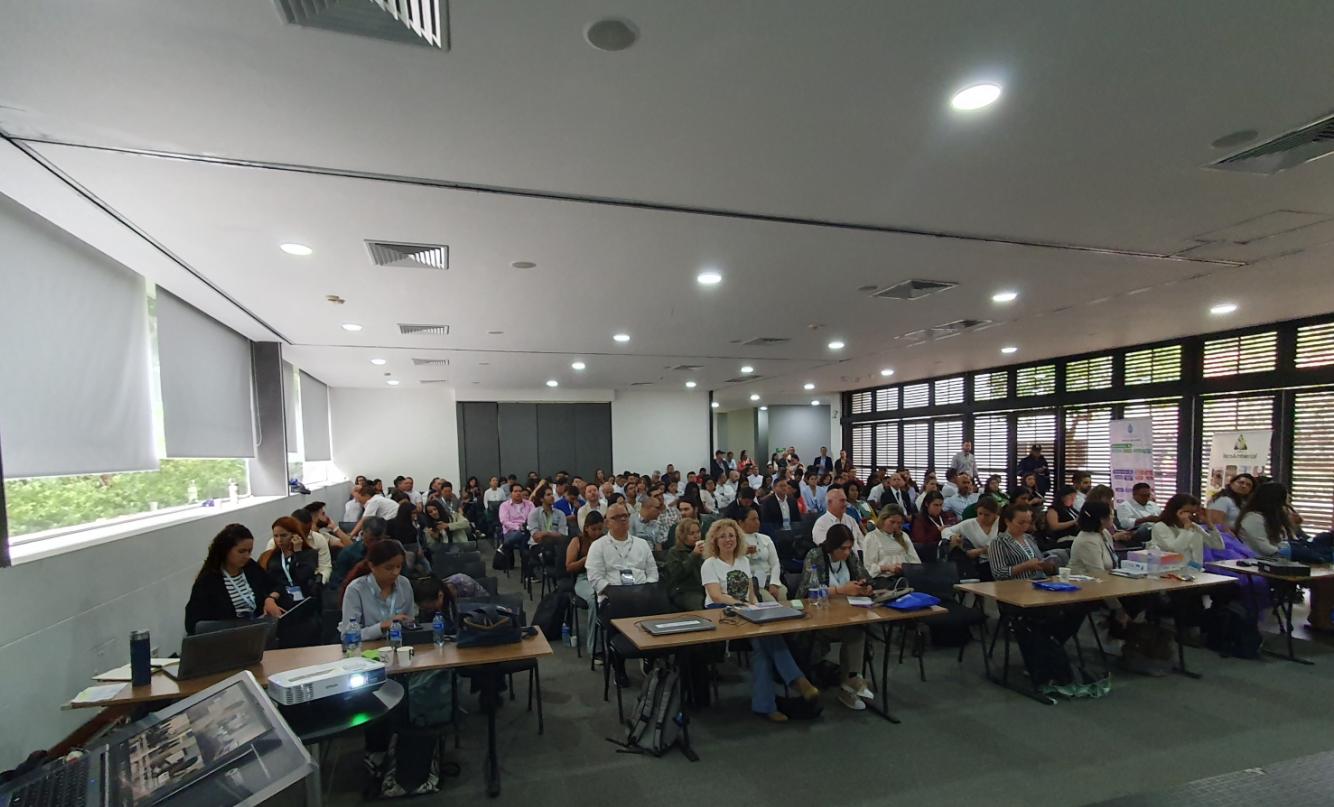
The city of Medellín hosted the First International Congress on Environmental Odour Management, organized by the Colombian Association of Sanitary and Environmental Engineering (ACODAL Noroccidente Branch) with support from olores.org, establishing itself as a key platform for knowledge exchange and technological solutions in odour emission control.
The event brought together over 310 professionals from academic, industrial, and environmental consulting sectors, exceeding attendance expectations. Alongside, the business fair featured 15 specialized companies showcasing innovative technologies in odour measurement, control, and mitigation, including continuous monitoring systems and bioremediation solutions.
The International Conference on Odour Management in Medellín (3-5 April 2025) brought together global experts to address technical and regulatory challenges in managing offensive odours. Before the main event, there was a pre-venue talk given by Mr. Ton van Harreveld, followed by a roundtable discussion with many odour experts. On the first day, Thursday, 3 April, the focus was on regulatory aspects and evaluation methodologies. Vania Zorich (Chile) presented AMIGO's initiatives for better global odour management, followed by an analysis of European legislation (Carlos Díaz Jiménez, Spain) and Colombian regulations (María del Carmen Cabeza, Bogotá). Environmental authorities discussed the implementation of Resolution 1541 of 2013, which regulates permissible odour levels in Colombia.
The academic programme highlighted innovative approaches such as the citizen science approaches for mapping odours according to the UNE 77270:2023 standard with interesting talks from Isabel de Lucas (Spain) and Rosa Arias (Spain). Gerhard Schleenstein (Chile) compared traditional methods with citizen observations, underscoring monitoring challenges. In parallel, analytical techniques like dynamic olfactometry were addressed, with contributions from Jaime Cardona Martínez (Medellín) on sampling and Patricio Ubilla (Chile) on low-cost materials for sample transport. Hans-Jürgen Störtz (Germany) concluded the day with industrial solutions for municipalities.
On Friday, 4 April, the focus shifted to engineering and success stories. Sebastián Pescador (Medellín) presented the odour control system at the Aguas Claras Wastewater Treatment Plant, combining gas scrubbers, activated carbon, and ionisation. Juan David Cifuentes (Bogotá) and Alejandro Calderón (Cali) shared advances in the pork and biotechnology sectors, while José Zapata (Cartagena) detailed strategies for his city's sewerage system. The session included economic comparisons of odour control systems (Pedro Ángel Vega, USA) and the use of precision sensors (Santiago Iraburu, Spain).
The event concluded on Saturday, 5 April with a technical visit to the Aguas Claras Plant, an example of comprehensive odour management.
The event’s success highlights the need to update Colombia’s regulatory frameworks for odour management, particularly in wastewater treatment, food, and petrochemical sectors. Organizers emphasized that 58% of environmental complaints in Colombia relate to odours, underscoring the technical relevance of these discussions.
In this event, the International Environmental Society of Odour Managers received an award collected by the president Vania Zorich. Also this media (olores.org) received an award that was collected by Carlos Diaz, Cyntia Izquierdo and Ainhoa Antón. Thank you for that guys!!
If you find this article interesting, you might be also interested in these articles.
- Regulatory process of offensive odors in Colombia
- Odour Emission is not an Issue any more in Colombia.The new Resolution 1541 has finally come true.
- NTC 5880. Approval of a new Air Quality Norm based on the EN 13725 in Colombia
- Ready the leaflet of the Odour Conference in Medellin, Colombia.
