Techniques

   There are different strategies to carry out environmental odour impact studies, such as emission studies based on the European Standard EN 13725 or immission studies based on the German Standard VDI3940. By means of these methodologies, it is possible to determine the origin of the nuisance caused by an industrial facility (or group of facilities) in its surroundings.

J. M. Juárez-Galán, A. Amo, J.V. Martínez y I. Valor
Aqualogy Medio Ambiente, C/Dracma 16-18, Polígono Industrial Las Atalayas. 03114 Alicante. Jmanuel.juarez@labaqua.com.

Keywords: EN 13725, Olfactometry, odour abatement, cost reduction.
 

sesion3_juarez01Abstract

    There are different strategies to carry out environmental odour impact studies, such as emission studies based on the European Standard EN 13725 or immission studies based on the German Standard VDI3940. By means of these methodologies, it is possible to determine the origin of the nuisance caused by an industrial facility (or group of facilities) in its surroundings. This diagnosis stage, allows to know the sources that are are truly responsible of the odour nuisance and therefore, to assess the most-effective corrective measures. Among these measures, there are several possibilities, from the increase of chimneys height to improve the dispersion conditions, to the implementation of an abatement system. Independently on the solution finally chosen, and considering the investment cost, the benefit for the company can be evaluated from two points of view. On one hand, there is a social benefit because the industrial activity is accepted by the social context since there is no negative impact. On the other hand, the information about the sources which are responsible of the odour nuisance allows to focus the economical investment to the operational units where it is required, saving money. In this paper, two case studies are presented. In both of them, due to the results obtained by an emission study based on EN 13725, several solutions have been proposed that have supposed important improvements when comparing them to the investments initially proposed without any odour study.

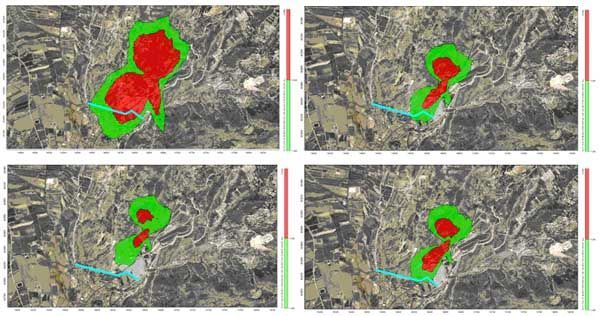
The aim of field inspections is to register the odours immediately recognized under real field conditions.

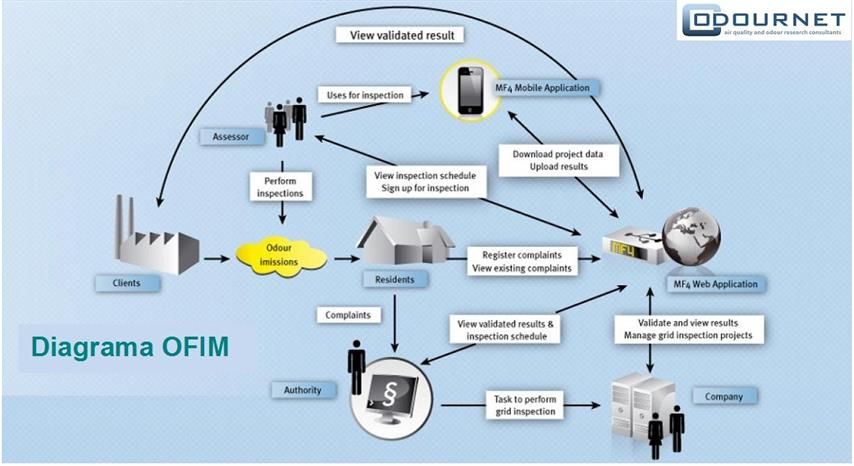
The main idea of field inspections is to estimate the degree of annoyance in a determined problematic area by means of the olfactory capacities of a group of people (or panel) specially trained and "calibrated" for this purpose. To this effect, the study area is divided in smaller assessment squares and the people of the panel is sent to the nodes of this squares at different times of the day and in a determined order to allow the most diverse conditions. Anytime a person of the panel reach a node, smells the air and take notes of odour parameters (Intensity, hedonic tone, etc.), weather conditions and some other data on site.

  Sponsored Content  

GC-IMS is no longer “just” an interesting technique for odour work – it is becoming the reference backbone for serious, defensible environmental odour analysis. Around the world, leading labs and consultants are quietly adding it to their toolbox and discovering how much more robust, fast and objective their odour assessments can become. GC-IMS (Gas Chromatography – Ion Mobility Spectrometry) delivers 2D separation, sub‑ppbv sensitivity and rugged, portable hardware that goes where the odour problem really is: at the stack, on the boundary, in the plant. With IMS operating at ambient pressure using a Tritium beta source (IAEA/EURATOM exempt, no licence required) and water-based reagent ions, you avoid vacuum systems, fragmentation and the associated dilution effects, while still obtaining direct, high‑quality VOC fingerprints you can correlate with sensory data.​

   For years, odour units have been accepted but often questioned by operators, regulators and neighbours because they lack chemical transparency. GC-IMS changes that equation by measuring real VOC fingerprints in gas samples at sub‑ppm level with orthogonal GC+IMS separation, providing high selectivity across a wide range of volatiles. The instruments are compact and rugged, can be integrated in mobile labs or vans with an on‑board nitrogen generator, and need only mains power on‑site. Instead of discussing “odour annoyance” in abstract terms, you can present two‑dimensional plots, peaks and fingerprints that clearly differentiate sources and operating conditions.​

More Articles …

All the content here under Creative Commons license