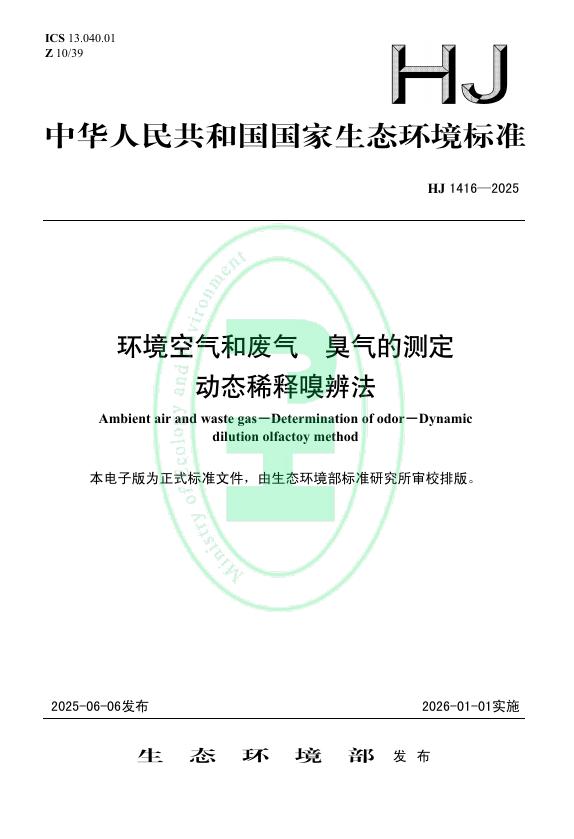
China has introduced the new environmental standard HJ 1416-2025 for the determination of odour concentration and emission rate by dynamic olfactometry. It was published on June 6, 2025, and is set to be implemented on January 1, 2026. The document is identified as a "Industry standard - environment" (Standard No. HJ 1416-2025), which is different from a national standard formally published by the Chinese National Standardization Administration (SAC). Although the methodology proposed is dynamic olfactometry, this 10-page standard is a basic text but technically aligned in many aspects with the recent 124-page EN 13725:2022.

   HJ 1416-2025 is an environmental industry standard issued by the Ministry of Ecology and Environment. The official full text in Chinese is publicly accessible from the Ministry of Ecology and Environment website and can be downloaded here. This standard establishes updated, scientifically rigorous methods for assessing odour pollution from ambient air and waste gas sources using dynamic dilution olfactometry with trained human assessors, aligning domestic regulatory practices with international advances in odour measurement.

   Australia has recently adopted the EN 13725:2022 standard for odour measurement, aligning its methodology with the latest European standard. The new AS EN 13725:2025 replaces the older AS/NZS 4323.3:2001, which was based on the 2003 European standard. The change introduces updates in calibration, uncertainty assessment, and sampling procedures.

   For those involved in environmental monitoring and odour assessment, understanding this update is important. The adoption of a transposed standard means that Australia now uses the same methodology as Europe, ensuring consistency in measurements.

   Working Group 41 of CEN convened in Paris (and online) on 16 June this year, with the main focus on resolving comments made to the drafts of Part 1 and Part 2 of the standard for Instrumental Odour Monitoring Systems (IOMS). Part 1 will deal with definitions and general aspects, Part 2 will address technical specifications and QA/QC requirements, and Part 3 will cover field validation. This is the second attempt by Working Group 41, following an earlier effort that was not successful.

   A week ago, the WG41 group gathered in Paris to discuss the progress of the two drafts currently in development. The group has been working for over three years on the first CEN standard for Instrumental Odour Monitoring Systems. On this occasion, the group reviewed around 150 comments, with over 110 coming from the Spanish mirror group.

More Articles …

Subcategories

All the content here under Creative Commons license