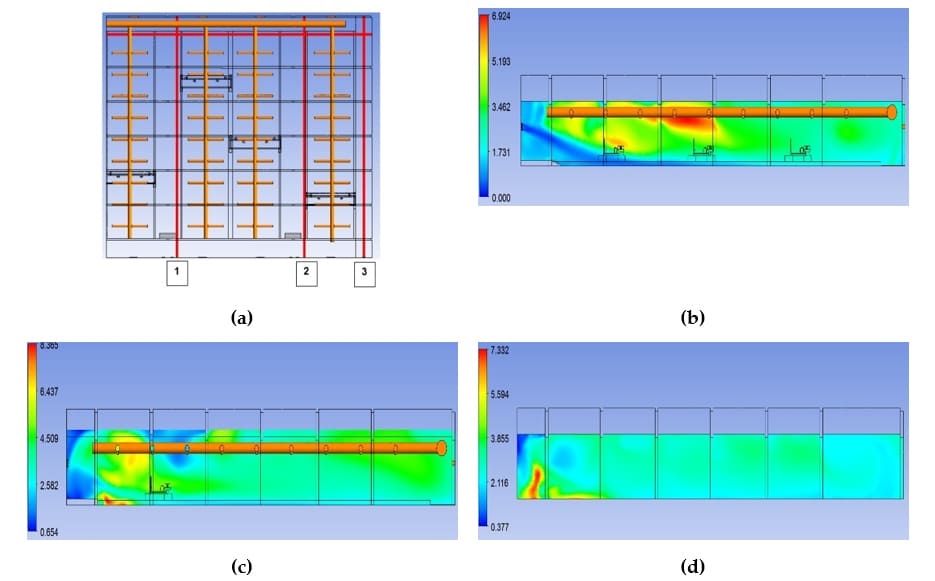
This study evaluates a push-pull ventilation system with localized extraction designed to reduce H2S concentrations in the settling stage of a wastewater treatment plant in Santiago, Chile.

   CFD simulations and field measurements show that the existing crossed ventilation system results in H2S concentrations up to 21 mg/m³ over the water surface. The improved push-pull system effectively lowers H2S levels in the plant corridors to below 7.5 ppm, complying with Chilean regulations.

I. Polanco1, M. Rodríquez1, A. Hammad2, A. Haddad3, V. Tam4  & D. Vasco1

Department of Mechanical Engineering, University of Santiago de Chile, Santiago, Chile. ivan.polanco@usach.cl
Faculty of Built Environment, University of New South Wales, Sydney, Australia
Department of Civil Construction, Federal University of Rio de Janeiro, Rio de Janeiro, Brazil
School of Built Environment, Western Sydney University, Penrith, NSW, Australia

   The agro-industrial sector generates emissions of gases such as methane, ammonia, and hydrogen sulfide, which affect air quality and contribute to climate change.

   The Ubiproc® system employs biological filtration through microbial biofilms in closed organic waste pits, combined with real-time gas monitoring to optimize management. Field trials demonstrated maximum removal efficiencies of 87% for ammonia and 70% for hydrogen sulfide, with consistently stable average performance throughout the operational period.

D. Sepulveda, G. Villouta, C. Carrasco & V. Leon

Research and Development Department, Bioproc SpA., Concepción, Chile

    The pulp industry faces challenges in balancing biological wastewater treatment with effective odor control.

   SciCorp’s micronutrient technology, based on plant extracts, selectively stimulates specific bacteria within biological sludge to significantly reduce emissions of malodorous gases such as hydrogen sulfide and mercaptans. Additionally, this technology enhances the biological treatment performance by increasing load capacity, lowering phosphorus concentration in the treated effluent, and reducing biosolid production, thereby optimizing overall wastewater treatment plant efficiency.

D. Maat1, J. Soza2 & J. Nuñez3

1SciCorp International, Mississauga ON, Canada.
2CMPC Pulp Maderas, Los Ángeles, Chile
3SciCorp International, Los Ángeles, Chile.

More Articles …

All the content here under Creative Commons license