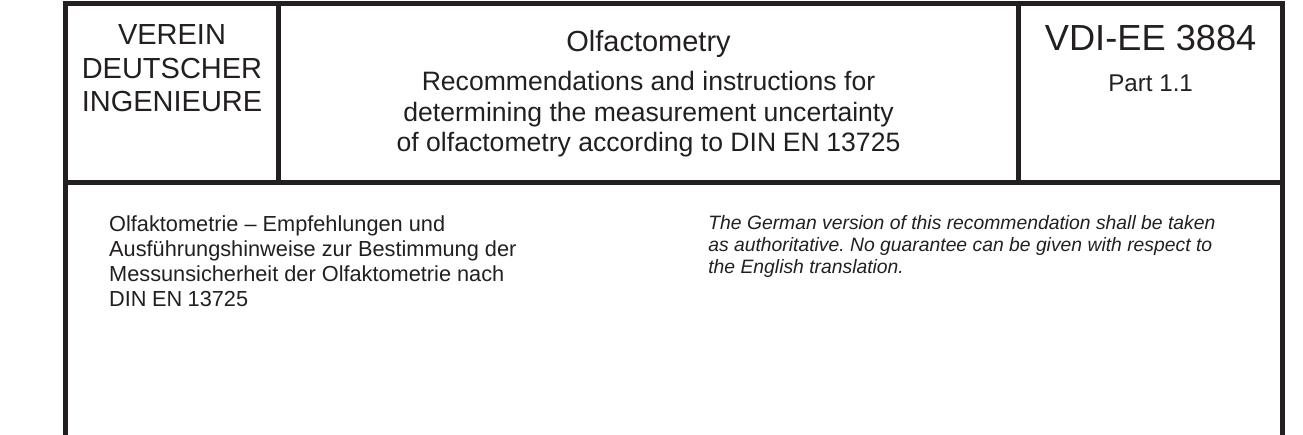
The German standard for calculating uncertainty in odour measurements—VDI-EE 3884 Part 1.1—was officially published in October 2024. That is a year ago, so why did we wait that long to publish something about this new standard? because it is a bit complex and there is a bit of a history here. That history started during the development of the revission of the EN13725 a few years ago. In the conversations related to the calculation of the uncertainty, there were two groups there, one that we will call the "Italo-Dutch" school and another one being the "German" school. The thing is that the Italo-Dutch school finally developed this part. The reasons why that happened are well beyond this simple journalistic piece of text, but the Germans were not happy about it, and this was the begining of the path that led to the standard VDI-EE 3884 Part 1.1.
The EN 13725:2022 standard came with a new set of statistical tools for calculating uncertainty. However, until now, work in certain areas related to the measurement of uncertainty in environmental samples had been purely theoretical. This aspect has undergone significant methodological revision in Germany in response to the results of a comprehensive comparative study. The new VDI-EE 3884 Part 1.1 standard modifies and corrects the method of calculating uncertainty, moving away from the core elements of the EN 13725:2022 standard.
To know a bit about these changes you might need to revisit a news we published about the last VDI conference in Leipzig a couple of years ago. At that time we published a bit of a summary of several presentations there. Among them, if you scroll a bit, you will see that there was one talk made by Mr. Gorden Bruyn who presented the findings from a comprehensive odour measurement initiative conducted at the sewage sludge drying facility at the Bottrop sewage treatment plant. The project, initiated by the VDI working group on olfactometry aimed to validate the new method outlined in EN 13725:2022 for determining measurement uncertainty in odour emission measurements.
A year later the VDI-EE 3884 Part 1.1:2024 was published, but why?
The old EN 13725:2003 standard did not establish any explicit procedure for determining measurement uncertainty. Since in Germany the Technical Directive on Air Quality Control (TA Luft) required a declaration regarding measurement uncertainty, it was necessary to develop a nationally coordinated proposal on this matter. Within the framework of Directive VDI 3884 Part 1 “Determination of the concentration of odorous substances by dynamic olfactometry – Application instructions for EN 13725”, published in February 2015, a procedure for determining measurement uncertainty was established as a supplement to EN 13725:2003.
The procedure described in VDI 3884 Part 1:2015 represented a pragmatic solution that enabled all measurement sites, in addition to other quality assurance measures, to determine their specific measurement uncertainty and indicate it in the accreditation process and measurement reports in accordance with Sections 26 and 28 of the German Federal Immission Control Act (BImSchG) and Section 41 of the Federal Immission Control Ordinance (BImSchV).
The new EN 13725:2022 standard established a completely different procedure for determining measurement uncertainty. The measurement uncertainty is determined from a combination of duplicate determinations of real environmental samples using two identical measuring devices (Method A6) in accordance with DIN EN ISO 20988:2007 and from the determination of the n-butanol olfactory threshold of the test panelists used.
However, to date, no comparative studies using olfactometric measurements were carried out in the context of developing the EN 13725:2022 standard. In other words, the specifications were established solely on the basis of theoretical considerations. The numerical example in Annex J of EN 13725:2022 is based on fictitious values.
In principle, it is positive that duplicate determinations of environmental samples taken from emission sources are being conducted, but validation was urgently needed. This is especially important because the requirements of EN ISO 20988:2007 cannot be literally met in olfactometric odor measurements. For example, measurement sites usually do not have two identical olfactometers for odor measurements. Moreover, the described procedure established a link to n-butanol measurements, whose usefulness has not been demonstrated.
In this context, a large comparative study was carried out in Germany in order to evaluate the possible effects of the new EN 13725:2022 standard.
A comprehensive proficiency test (Ringversuch) was run in Germany across twelve accredited labs, comparing various standards for uncertainty, including the EN 13725:2022 method, the long-standing VDI 3884 method, and ISO 20988 methodologies (A6 and A7). The results of this study revealed that inclusion of the n-butanol bias neither improved accuracy nor reflected measurable reality for environmental samples. Expanded uncertainties calculated by the EN 13725:2022 method were not only higher on average (up to 3.8 dBod) but also non-symmetric, sometimes with positive lower confidence limits—contradicting the fundamentals of measurement science.
The approach in EN 13725:2022 requires combining double determinations on environmental samples and a systematic deviation estimated with n-butanol odour threshold data. However, comparative measurements and statistical evaluations found fundamental issues. The EN 13725 logic introduced asymmetric uncertainty intervals and, in some cases, impossible confidence intervals, clashing ISO 20988 principles and leading to implausible uncertainty bounds for real-world environmental samples.
After analysing the results of this large study, the German Expert Recommendation, published the VDI-EE 3884 Part 1.1, abandoning the n-butanol-based correction for environmental sample uncertainty. The new approach aligns directly with ISO 20988 (method A6) for within-laboratory measurements: it is purely based on empirical double determinations of real samples, with different panel compositions, using paired measurements as the only accepted source of uncertainty evidence.
For those wishing to obtain the standard or access its full expert recommendations, it can be purchased directly through DIN Media’s portal at:
https://www.dinmedia.de/en/technical-rule/vdi-ee-3884-blatt-1-1/382907545.
This new standard applies to all laboratories in Germany conducting olfactometric measurements under EN 13725.
If you find this article interesting, you might also be interested in these articles:
- Is this the end of n-butanol for olfactometry?
- Odours in the Environment, a different kind of conference organised by the Association of German Engineers VDI
- The call for the HNLUG interlaboratory proficiency test involving stack sampling uncertainty is open again.
- A Resounding Success: Odour in the Environment 2023 VDI Conference in Leipzig Draws Praise from over 160 Attendees
- EN 13725:2022 is finally published!
