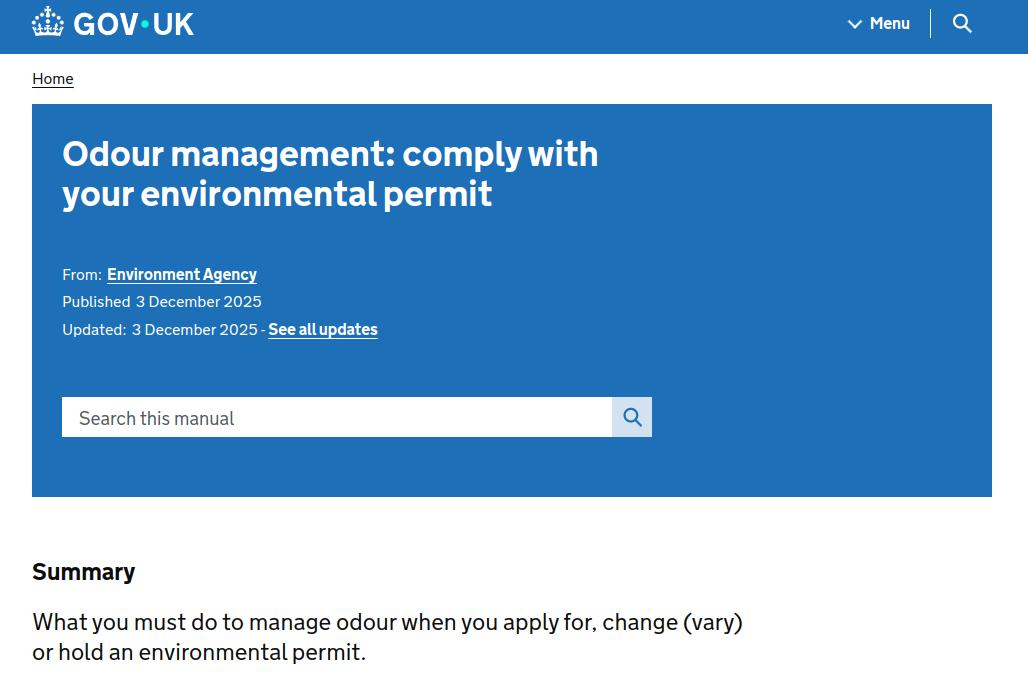
The UK Environment Agency has replaced its long‑standing H4 odour guidance last updated in 2009 with a new GOV.UK guidance hub titled “Odour management: comply with your environmental permit,” a change that removes many of H4’s previously detailed technical prescriptions and moves regulation toward demonstrating compliance with best available techniques (BAT) and appropriate measures. In addition, the odour limits are gone.
The H4 document (now withdrawn) used to provide extensive technical guidance, including benchmarked odour assessment approaches, structured testing and recommended modelling practice. The first H4 Horizontal Guidance for Odour was published in 2002 and included the first odour limits set in the UK. In 2009 this Guidance was updated but the odour limits based on percentiles 98 were left untouched. Sixteen years later the Agency has concluded that the H4 format was out of date and replaced it with a new online guidance which is shorter (no pdf here) and more principle‑based.
Reducing the guidance from 46 pages to six concise web-based sections with substantially reduced detail has rendered the text more open to interpretation and less prescriptive. One of the most notable removals is the absence of explicit odour limits in the new material; whereas the previous H4 discussed example boundary benchmarks and structured odour limits based on hedonic tones, the current guidance places emphasis on whether an operator is using sector BAT or other appropriate measures to prevent odour pollution rather than meeting fixed numeric targets.
Dispersion modelling and sniff testing (not to be confused with dynamic olfactomery), both very much detailed in the old H4 approach as standard assessment tools, are now downplayed. Modelling is mentioned only as one of several optional tools and sniff‑type field assessments are no longer presented as a tool, with the newer framework prioritising practical management measures and real‑world evidence.
The Agency has also introduced a clearer three‑part test/criteria for determining an odour pollution category; that categorisation is the operational benchmark used in enforcement and permit compliance checks, and it places case officers’ judgements about frequency, offensiveness and exposure at the heart of decisions.
Complaints handling has gained much greater prominence: the new guidance expects logging, investigation and response procedures for odour complaints and points members of the public to a new online form to report odour directly to the Agency. This complaint‑centred approach benefits enforcement where there is an existing complaint record but is less useful for prospective, new developments that naturally lack a complaint history.
For operators and applicants the practical takeaway is straightforward: relying on sector BAT/appropriate measures and an odour management plan (OMP) is now the primary compliance route, while modelling, sniff surveys and numeric thresholds are optional supporting evidence rather than mandatory boxes to tick. Review of sector‑specific BAT guidance and strong complaints procedures is recommended.
If you find this article interesting, you might also be interested in these articles.
- Best Practice in Odour Control Management, 6th of February 2014, Nottingham, UK.
- The H4 Odour Management Guidance has been recently revised.
- When Theory does not Match Common Sense. A typical Case Study of an Intensive Pig Farm in the UK
- World's First International Odour Exposure Handbook Released after Three Years of Collaborative Effort
- A Successful 11th VDI Conference Odours in the Environment
